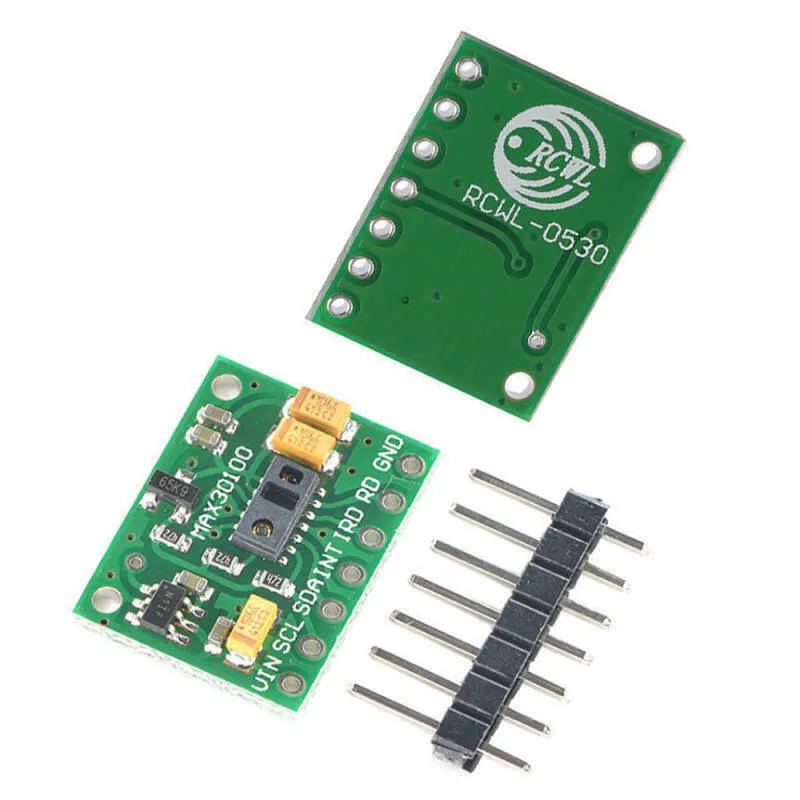
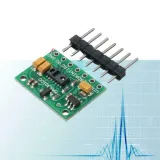
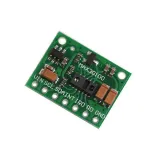
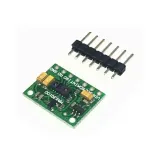
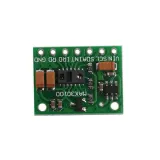
SKU: OT3616 Article number: NB110 EAN: 8720828223055
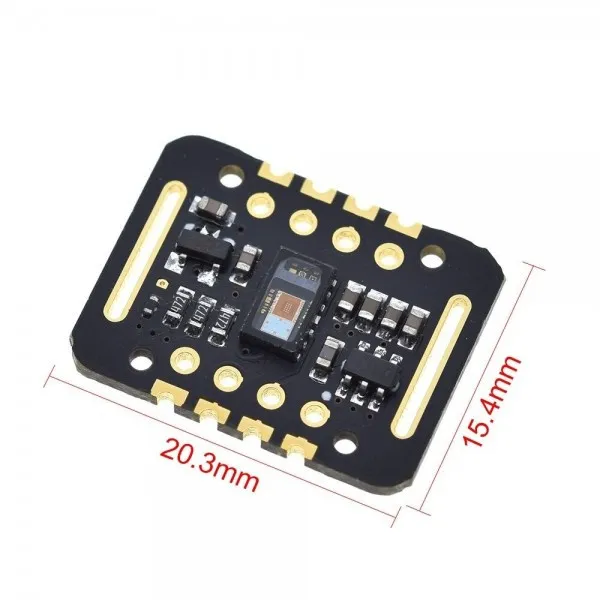
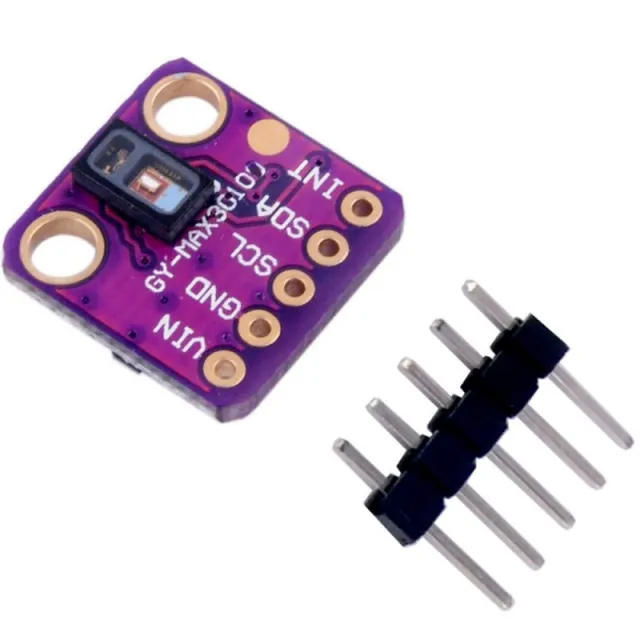
The MAX30100 is a sensor solution for SpO2 and heart rate measurement. It combines two LEDs, a photodetector, optimized optics, and low-noise analog signal processing to detect pulse oximetry and heart rate signals.
You can use this sensor with any microcontroller such as Arduino, ESP8266, or ESP32 to easily measure the patient's health parameters. This inexpensive DIY pulse oximeter sensor can be used in multiple applications if you are a beginner or an electronics enthusiast.
The MAX30100 sensor can measure blood oxygen and heart rate. We can use any display such as a 16x2 LCD screen to view the value of SpO2 and BPM. The oxygen concentration in the blood, called SpO2, is measured in percentage and the heart rate/pulse frequency is measured in BPM.
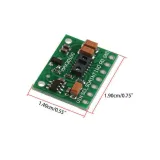
size: 30 * 20 mm
Features an advanced oximeter and heart rate sensor, which operates based on two integrated LEDs, a photosensitive element, and a highly accurate and advanced low-noise analog front end, for clean and precise measurements.
By placing, for example, an index finger on the top of the sensor, you can obtain both the heart rate and blood oxygen saturation via the I2C interface.
Functions such as Ambient Light Cancellation (ALC) and discrete time filters ensure that no ambient light or 50/60Hz interferes with the measurements.
One of the main features of this device is the low power consumption: it is possible to put the device in Standby mode, where it has very low power consumption.
All in all, this module is an ideal solution for various heart rate and SpO2-related applications, as well as the development of new algorithms for reading blood parameters based on the red and infrared absorption properties of the human body, mainly for arterial blood oxygen saturation (SpO2) and heart rate (HR).
The measurement of hemoglobin oxygen saturation (HbO2) by measuring the absorption of red and IR light from the pulsating components was introduced in 1935 by Karl Matthes, a German physician. In the beginning, there were no good photodetectors and instead, the IR band, the green band of the light spectrum, was used. As technology advanced, more reliable methods for light detection were developed and green light was replaced by IR light. Today, advanced algorithms allow separation between the signals of pulsating arterial blood and moving venous blood, enabling more accurate and reliable measurements. The sensor on this module, the MAX30100, is a modern, integrated pulse oximeter and heart rate sensor IC.
This sensor has two integrated LEDs with the RED and IR LEDs, which are used to emit the respective wavelengths. The wavelengths of these LEDs are 660nm and 880nm, respectively. The reflected light is detected by a red/IR photodetector element and sampled by a low-noise delta-sigma 16-bit ADC. The analog front end of the MAX30100 sensor features an Ambient Light Cancellation (ALC) section, which eliminates light pollution from the photodetector element. The 16-bit ADC is filtered by a discrete time filter to prevent 50/60Hz interference and hum. The output sampling frequency can be adjusted from 50 Hz to 1 kHz. There is also a temperature sensor, which can be used to compensate for changes in the environment and calibrate the measurements.
The MAX30100 sensor has a FIFO buffer, 16 words deep. The FIFO buffer stores the measured values and can generate an interrupt when the buffer is full, allowing the host MCU to perform other tasks while the data is being collected by the sensor.
The integrated LED drivers are operated with pulses of selectable width: pulses can range from 200 µs to 1600 µs. The width of the pulse affects the available ADC bit depth and sample frequency. The pulse width of 1600 µs allows a maximum resolution of 16 bits with the highest sample frequency of 1 ksps, while the pulse width of 200 µs only allows 100 sps for a resolution of 16 bits. By lowering the resolution to 13 bits, the full sample rate of 1 ksps is possible. Control of the LED pulse width, along with the programmable LED current, ensures optimization of measurement accuracy and power consumption. The power supply for the LEDs comes directly from the 3.3V rail of the mikroBUS™.
To improve the measurements, the MAX30100 sensor uses a temperature sensor. This is a reasonably accurate temperature sensor, which measures the die temperature with an accuracy of ±1C in the range of -40C to +85C. This sensor can be read from its data register and can optionally be used to compensate the sensor measurements for fluctuations in ambient temperature. However, there are several other external factors that can affect the accuracy of the device: in addition to temperature, the measurements can also be negatively affected by excessive movement. Too much pressure can also constrict the capillary blood flow and thus reduce the reliability of the data. These problems arise from the nature of the measurement method and should be considered when developing your own application.
The MAX30100 sensor is powered by the small LDO, which provides clean and ripple-free 1.8 V for the internal logic and the photodetector element of the sensor. The input voltage also comes from the 3.3V power rail of the mikroBUS™.
In addition to the I2C lines of the sensor IC, which are routed to the respective mikroBUS™ SCL and SDA lines, the interrupt line of the sensor is also routed to the mikroBUS™ INT pin. By setting the appropriate INT register, the interrupt can be generated and enabled for 5 different sources: power ready, SpO2 ready, HR ready, temp ready, FIFO full. The power ready interrupt is enabled by default and cannot be disabled in the software, but all other interrupts can be disabled or enabled.