ESP32-S3 Super Mini 4MB Flash and 2MB PSRAM
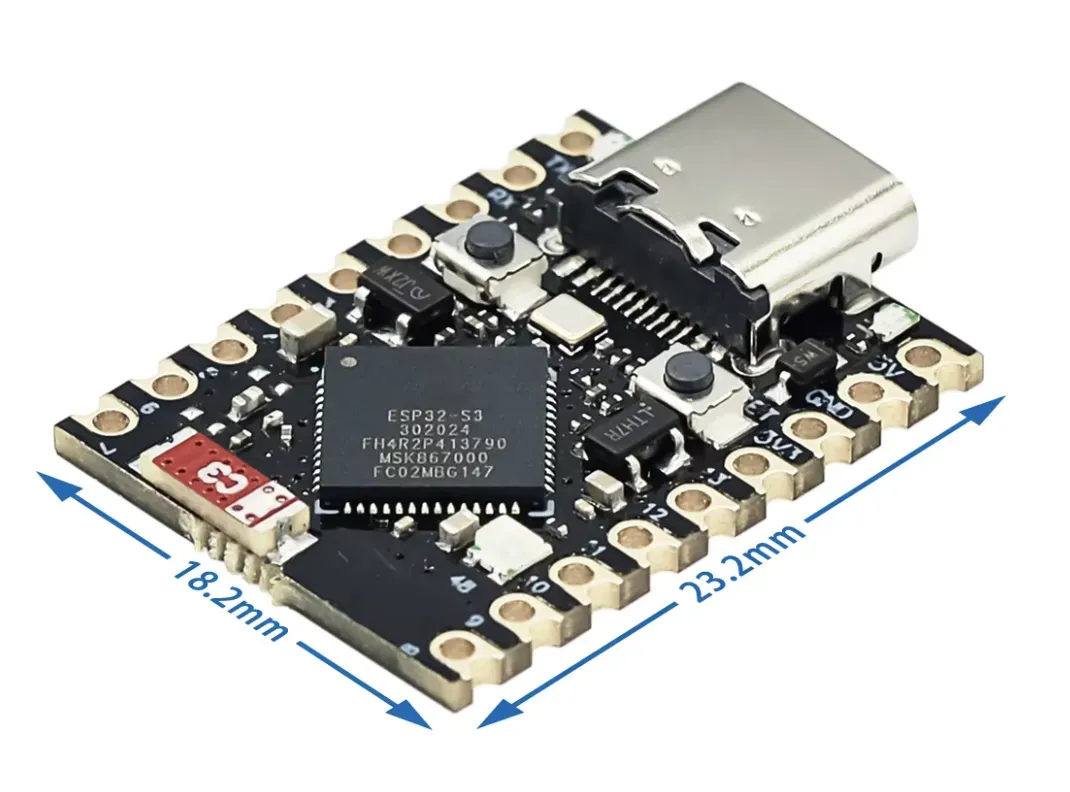
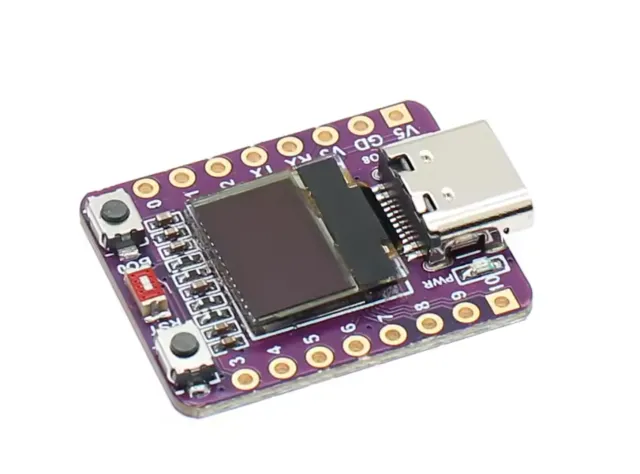
The ESP32-S3 Super Mini is a small and powerful development board for IoT, home automation, sensors, displays, USB devices, and embedded electronics. The board features a fast dual-core ESP32-S3 processor, built-in WiFi, Bluetooth Low Energy, native USB, 4 MB flash memory, and 2 MB PSRAM.
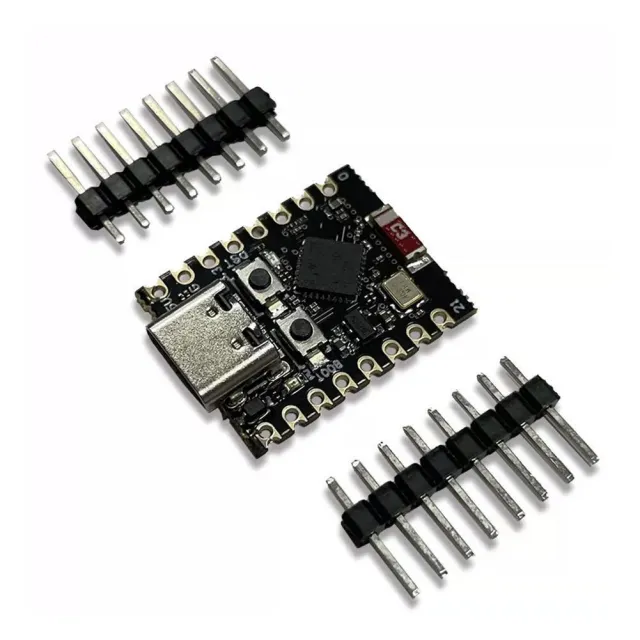
With a size of approximately 22.52 × 18 mm, this board offers plenty of processing power and connectivity options in a small footprint. The standard 2.54 mm pin spacing makes integration into various projects easy. The included pin headers must be soldered on by yourself.
Main features
- ESP32-S3 dual-core Xtensa LX7 processor up to 240 MHz
- 4 MB flash memory and 2 MB QSPI PSRAM
- 512 KB internal SRAM and 384 KB ROM
- 2.4 GHz WiFi and Bluetooth 5 Low Energy
- Native USB via USB-C, without an extra USB-to-serial converter
- 32 GPIO connections, 16 ADC inputs
- Programmable WS2812 RGB LED and status LEDs
- Support for Arduino IDE, PlatformIO, ESP-IDF, ESPHome, and MicroPython
- Firmware upload via USB and OTA
- Compact size: approximately 22.52 × 18 mm
Technical specifications
- Microcontroller: ESP32-S3
- Processor: Dual-core Xtensa LX7, 240 MHz
- Internal SRAM: 512 KB
- ROM: 384 KB
- Flash memory: 4 MB
- PSRAM: 2 MB QSPI
- WiFi: 2.4 GHz IEEE 802.11 b/g/n
- Bluetooth: Bluetooth 5 Low Energy
- USB connection: USB-C (native USB 2.0, USB OTG, USB Serial/JTAG)
- GPIO: 32 pins
- ADC: 16 inputs
- UART: Up to 3 controllers
- I²C: Up to 2 controllers
- SPI: Up to 4 controllers
- PWM: Up to 8 channels
- Logic level: 3.3 V
- Power supply: 5 V via USB-C or 5V pin
- Dimensions: Approximately 22.52 × 18 mm
- Pin spacing: 2.54 mm
Connections and pins
The board has 37 connection positions, of which 32 can be used as GPIO. There are also connections for 5 V, 3.3 V, and GND. Commonly used GPIO pins without special functions during boot include:
- GPIO1, GPIO2, GPIO4, GPIO5, GPIO6, GPIO7, GPIO8
- GPIO15, GPIO16, GPIO17, GPIO18, GPIO21
Always check the pinout and software requirements for permanent connections, as some pins may have special functions during startup or debugging.
Built-in LEDs and buttons
- Programmable WS2812 RGB LED (connected to GPIO48)
- Red status LED (connected to GPIO48)
- Blue charging status LED (for battery, not software-controlled)
- BOOT button
- RESET button
Enabling PSRAM
The 2 MB PSRAM is not enabled by default in all development environments. In Arduino IDE, you must explicitly select “QSPI PSRAM” in the board settings. In PlatformIO and ESPHome, specific configurations are also required to activate PSRAM.
Programming and use
The USB-C port is directly connected to the native USB interface, so no extra USB-to-serial converter is needed. For programming via Arduino IDE, “USB CDC On Boot” must be enabled.
If the board is not recognized or the upload fails, follow these steps:
- Hold down the BOOT button
- Connect the USB cable or briefly press RESET
- Start the firmware upload
- Release the BOOT button
- Press RESET after uploading to start the program
Communication and peripherals
The ESP32-S3 Super Mini supports various interfaces: GPIO, ADC, PWM, UART, I²C, SPI, I²S, USB, WiFi, and Bluetooth Low Energy. This makes it suitable for sensors, relays, displays, LED strips, motor controllers, memory modules, and other digital or analog components.
Possible applications
- IoT sensors and wireless measurement equipment
- Home automation and automation (Home Assistant, ESPHome, MQTT)
- Displays and graphical interfaces
- Data loggers and robotics
- USB-HID devices, keyboards, and controllers
- LED strips and interactive lighting
- Bluetooth Low Energy devices
- Audio and speech processing
- Compact embedded systems and edge AI applications
Package contents
- 1× ESP32-S3 Super Mini development board
- Matching pin headers (not soldered on yet)
Note
- Pin headers must be soldered on by yourself
- A USB-C cable with data support is required for programming
- GPIO operates at 3.3 V logic level and is not 5V tolerant
- Always check the pinout and function of connected components