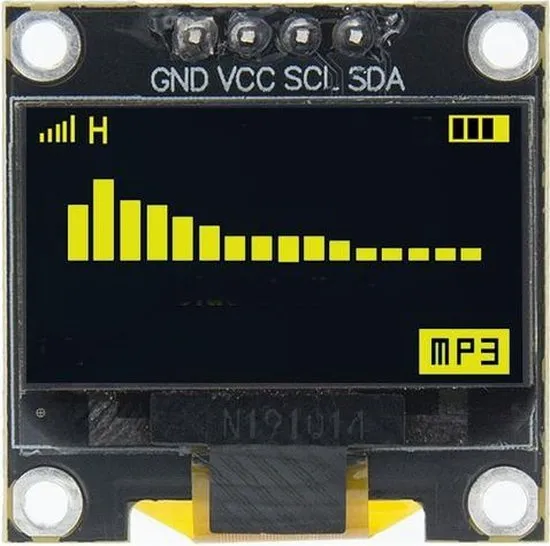
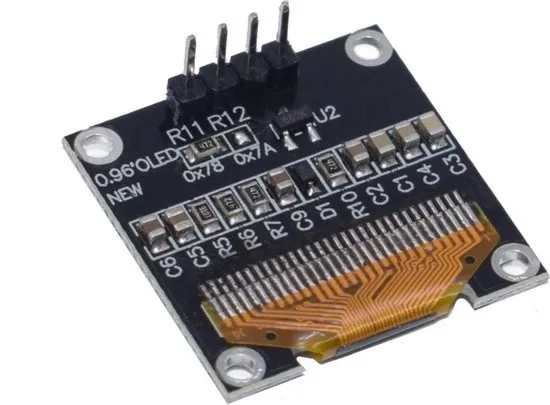
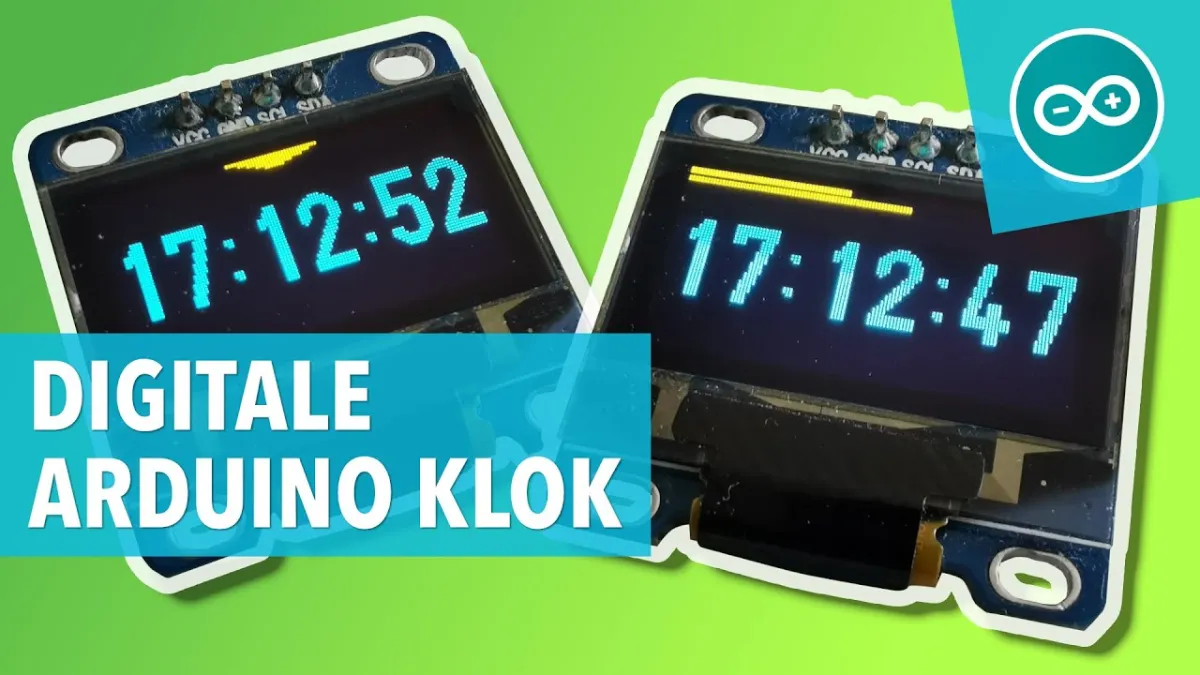
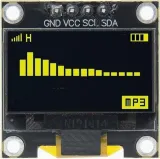
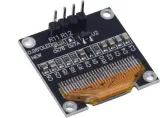
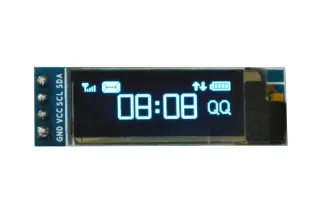
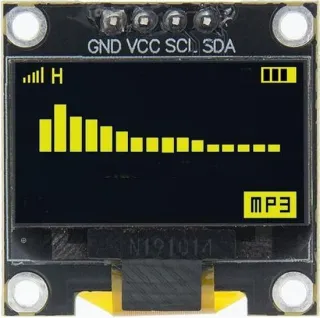
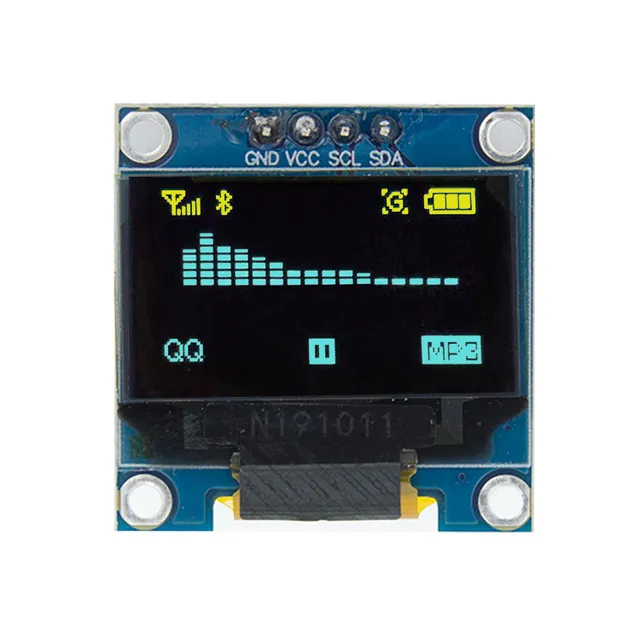
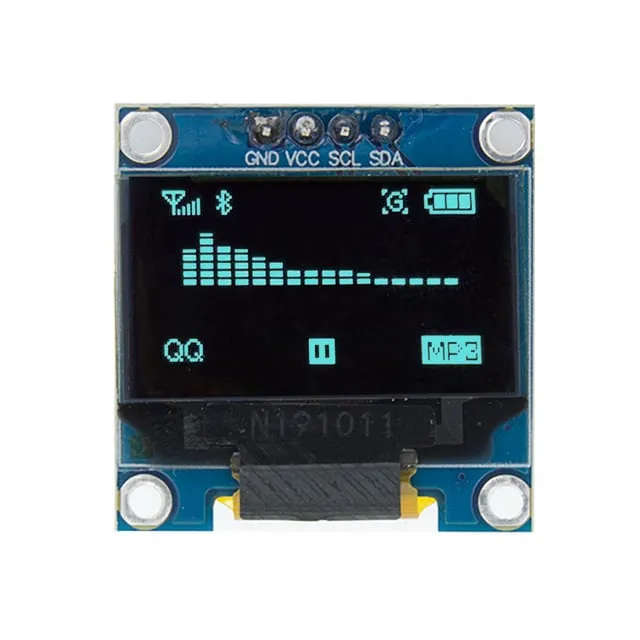
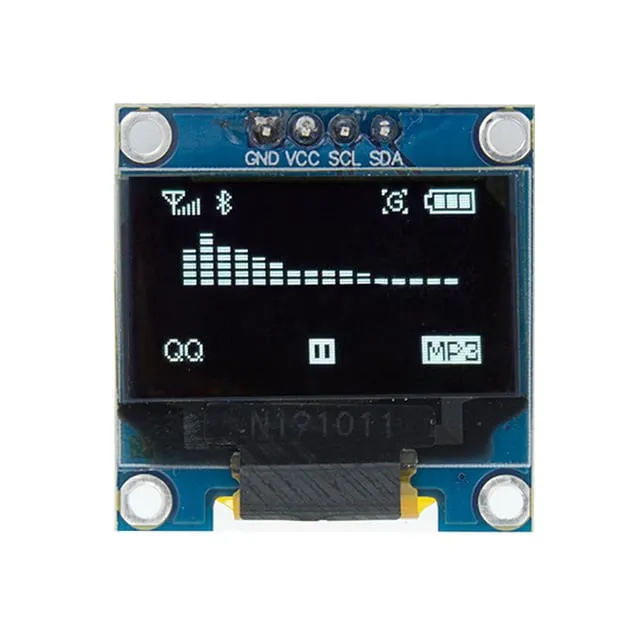
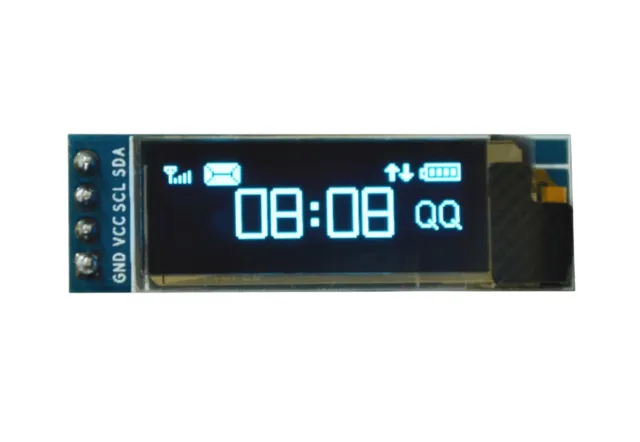
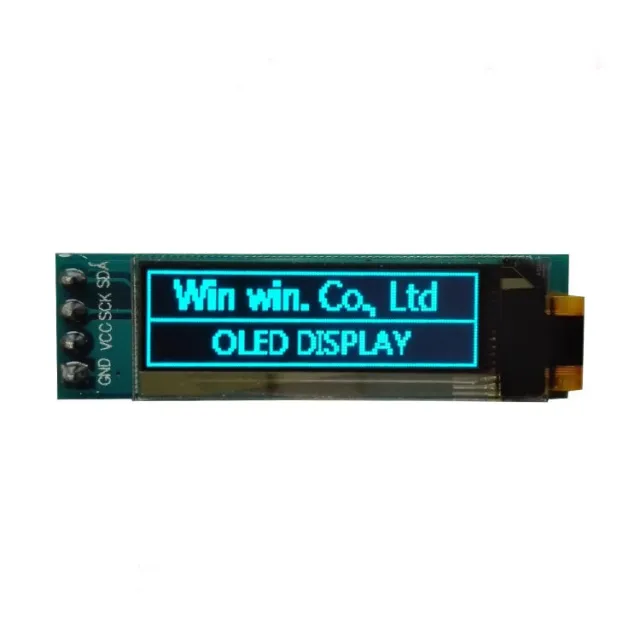
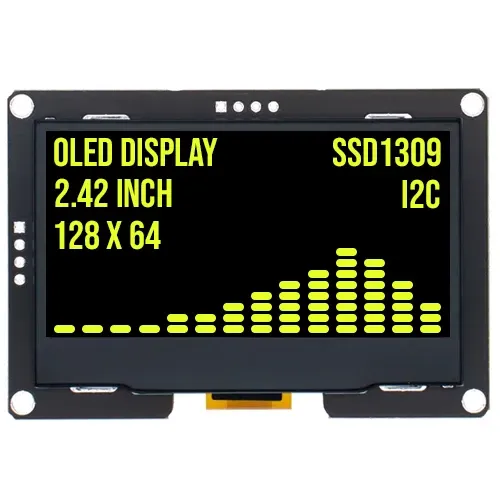
Compact 0.96-inch yellow OLED display for Arduino and ESP32/ESP8266 projects.
SKU: OT823-C64 Article number: XM968 EAN: 2115440195952 Location: C06.04
Alternative
Mini OLED display with 0.91 inch 128x32 I2C
€ 2,99
View this alternative
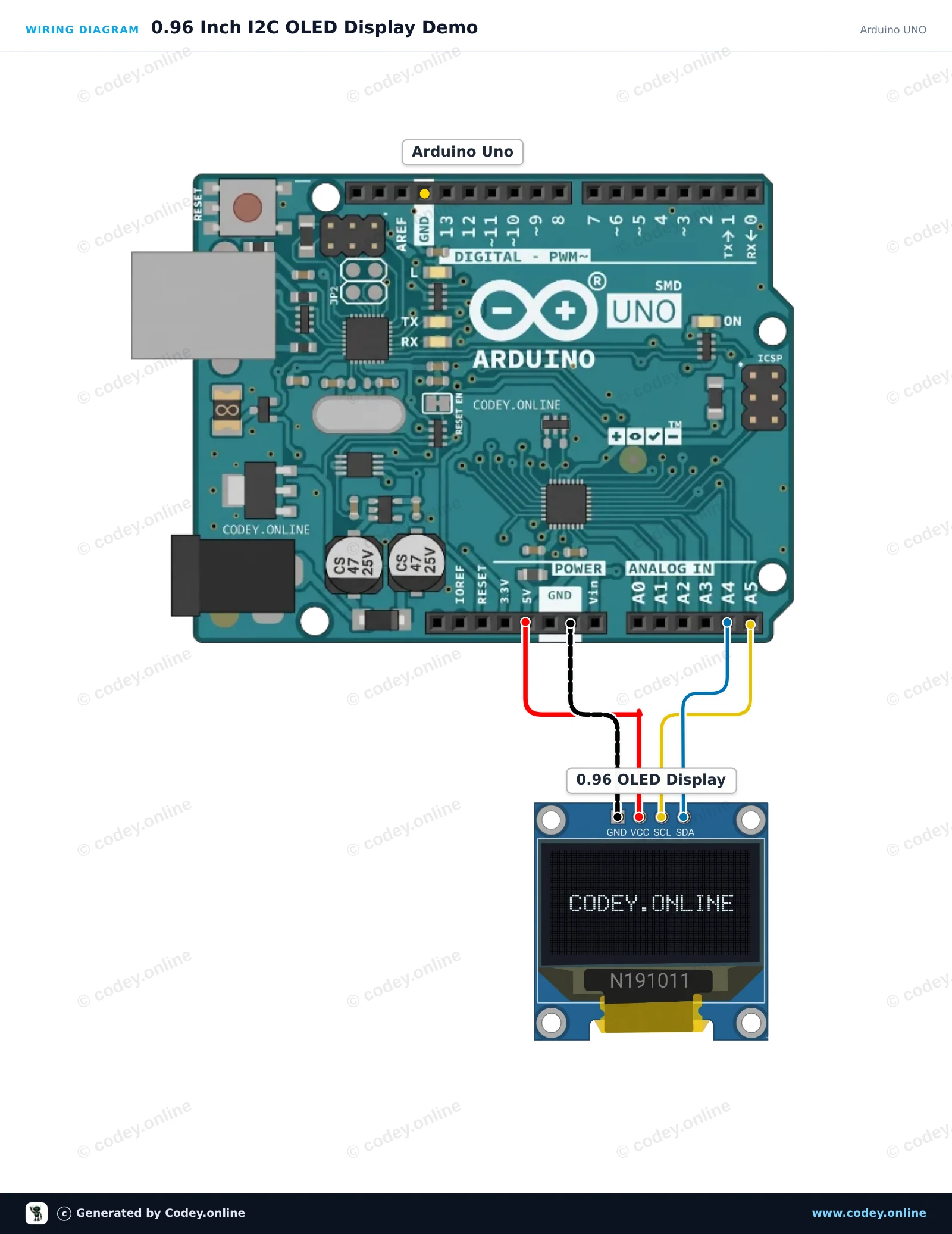
How to connect the Mini OLED display yellow 0.96 inch 128x64 I2C to an Arduino UNO or ESP32, with an example sketch you can upload straight away.
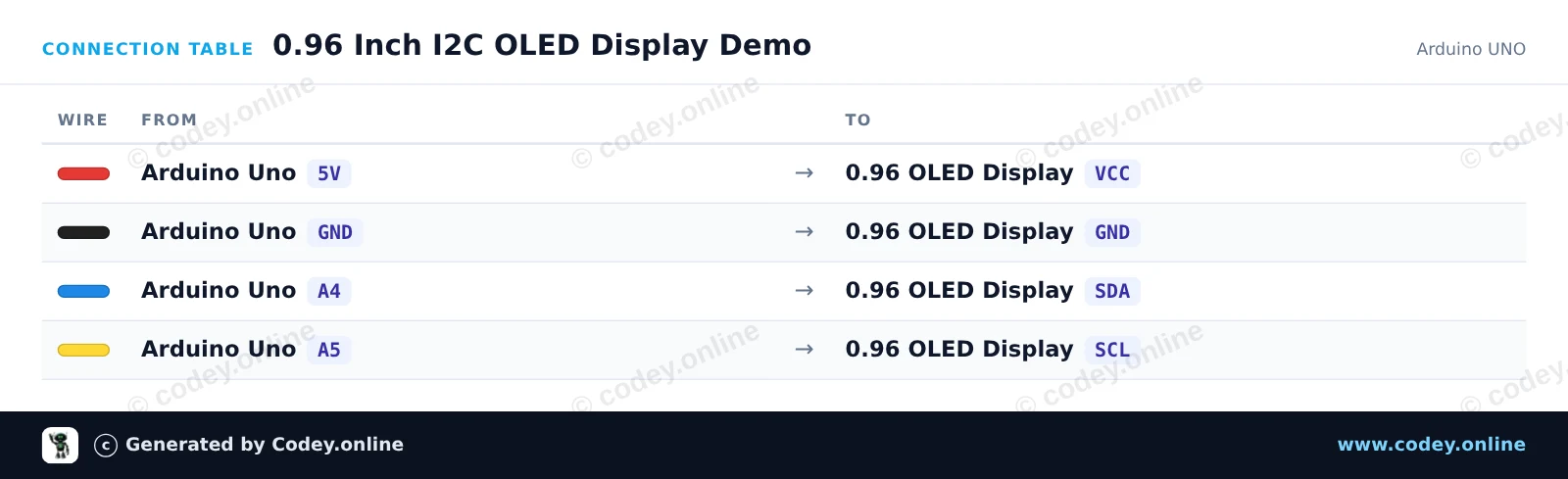
Connects the 0.96-inch I2C OLED display (SSD1306) to the Arduino Uno to display text, lines, and an incrementing counter. The display communicates over I2C using A4 for SDA and A5 for SCL. U8g2 manages the display rendering using an efficient page buffer.
/*
* ==================================================================
* Generated by Codey.online — https://www.codey.online
* ==================================================================
* Project : 0.96 Inch I2C OLED Display Demo
* Board : Arduino UNO (arduino:avr:uno)
* Parts : OLED Display 0.96 inch
* Libraries : U8g2 2.36.19
*
* Codey Online is an AI-powered browser IDE for Arduino and ESP32.
* Describe your project and Codey writes the code, draws the wiring
* diagram and uploads it to your board, straight from the browser.
* This code is free to use, modify and share, without warranty.
* ==================================================================
*/
#include <Wire.h>
#include <U8g2lib.h>
// 128x64 SSD1306 noname I2C display using page buffer (low RAM usage)
U8G2_SSD1306_128X64_NONAME_1_HW_I2C u8g2(U8G2_R0, /* reset=*/ U8X8_PIN_NONE);
int counter = 0;
void setup() {
Serial.begin(115200);
u8g2.begin();
}
void loop() {
u8g2.firstPage();
do {
u8g2.setFont(u8g2_font_ncenB08_tr);
u8g2.drawStr(0, 12, "0.96\" OLED Demo");
u8g2.drawHLine(0, 15, 128);
u8g2.drawStr(0, 32, "Uptime:");
u8g2.setCursor(60, 32);
u8g2.print(millis() / 1000);
u8g2.print(" s");
u8g2.drawStr(0, 50, "Count:");
u8g2.setCursor(60, 50);
u8g2.print(counter);
} while (u8g2.nextPage());
counter++;
delay(1000);
}
Required libraries: U8g2 2.36.19
Wiring diagram and example code generated by Codey.online — https://www.codey.online
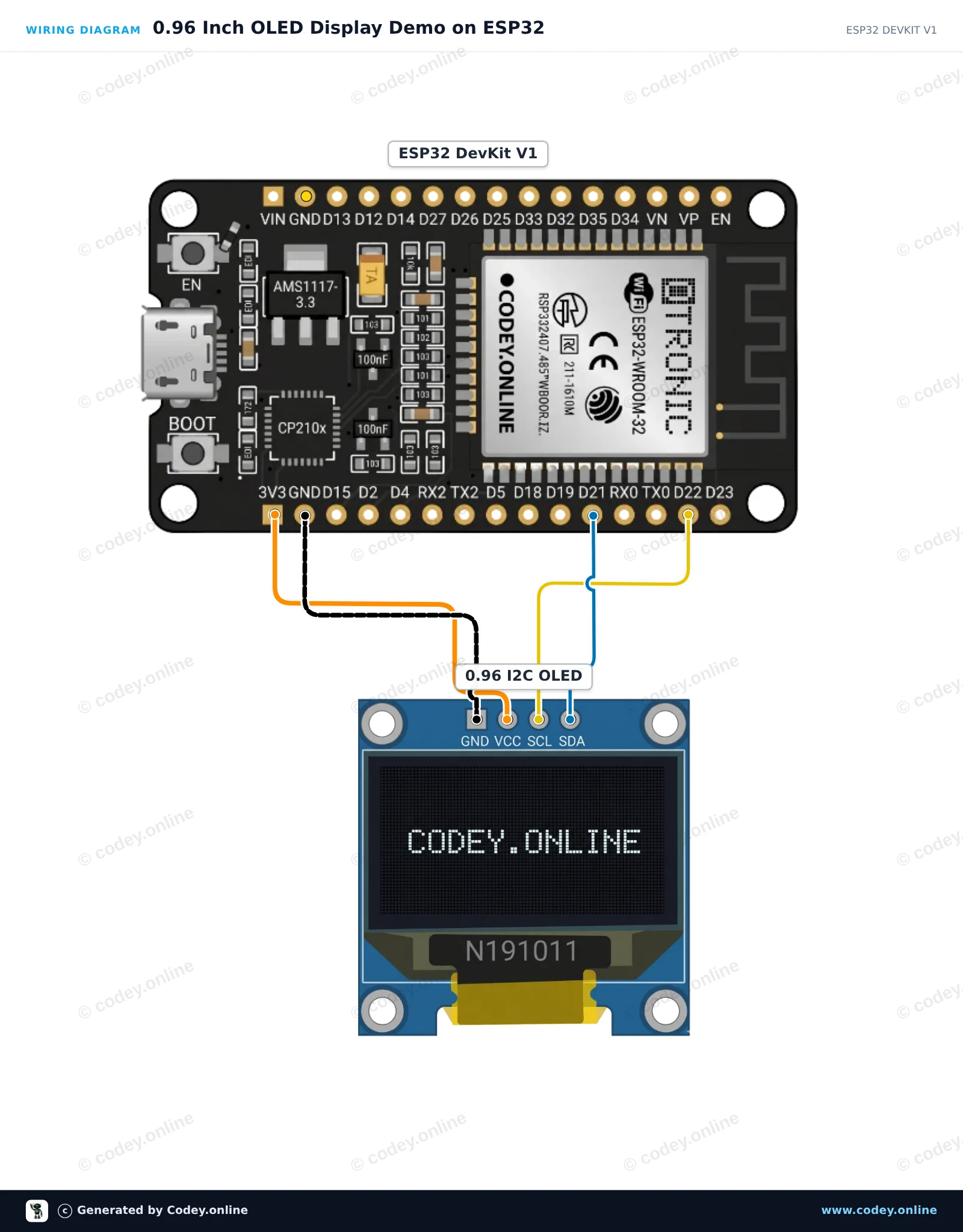
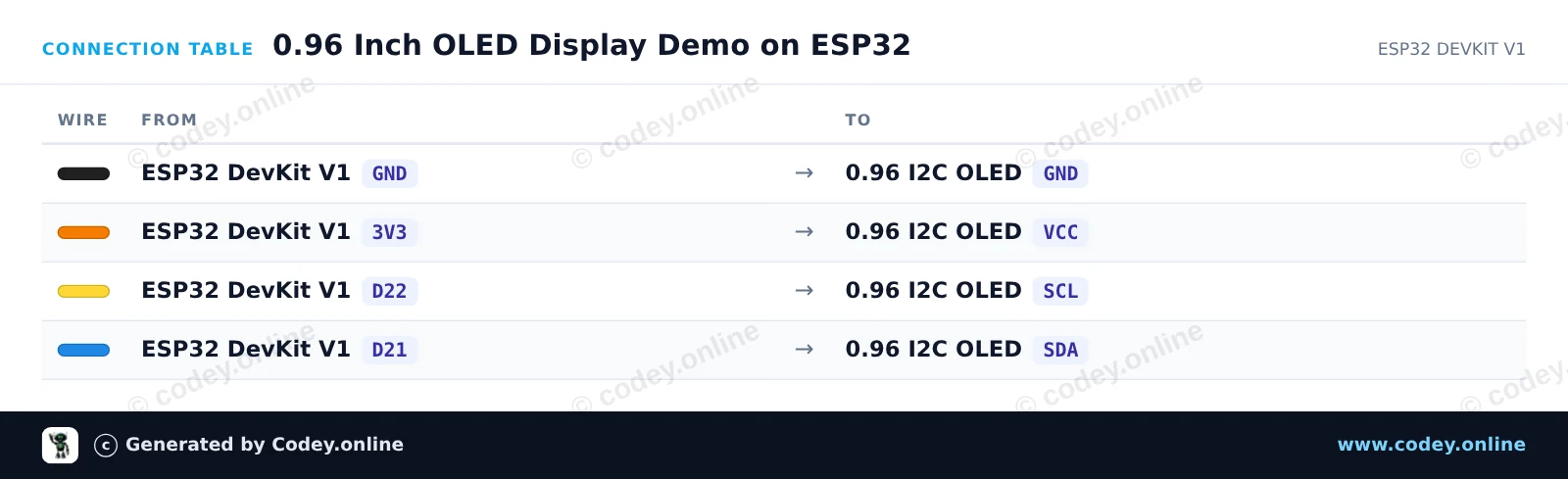
This project connects a 0.96 inch I2C OLED display (SSD1306) to an ESP32. The sketch initializes the display and presents a simple welcome message along with an updating uptime counter. It is a quick and clean way to verify your display is working.
/*
* ==================================================================
* Generated by Codey.online — https://www.codey.online
* ==================================================================
* Project : 0.96 Inch OLED Display Demo on ESP32
* Board : ESP32 DEVKIT V1 (esp32:esp32:esp32doit-devkit-v1)
* Parts : OLED Display 0.96 inch
* Libraries : Adafruit SSD1306 2.5.16, Adafruit GFX Library 1.12.6
*
* Codey Online is an AI-powered browser IDE for Arduino and ESP32.
* Describe your project and Codey writes the code, draws the wiring
* diagram and uploads it to your board, straight from the browser.
* This code is free to use, modify and share, without warranty.
* ==================================================================
*/
#include <Wire.h>
#include <Adafruit_GFX.h>
#include <Adafruit_SSD1306.h>
#define SCREEN_WIDTH 128
#define SCREEN_HEIGHT 64
#define OLED_RESET -1
#define SCREEN_ADDRESS 0x3C
Adafruit_SSD1306 display(SCREEN_WIDTH, SCREEN_HEIGHT, &Wire, OLED_RESET);
int counter = 0;
void setup() {
Serial.begin(115200);
// Initialize I2C with default ESP32 pins (SDA=21, SCL=22)
Wire.begin(21, 22);
if (!display.begin(SSD1306_SWITCHCAPVCC, SCREEN_ADDRESS)) {
Serial.println(F("SSD1306 allocation failed"));
while (true); // Freeze if display initialization fails
}
display.clearDisplay();
display.setTextColor(SSD1306_WHITE);
display.setTextSize(1);
display.setCursor(10, 10);
display.println("ESP32 OLED Test");
display.display();
delay(2000);
}
void loop() {
display.clearDisplay();
// Header
display.setTextSize(1);
display.setCursor(0, 0);
display.println("ESP32 DevKit V1");
display.drawLine(0, 10, 127, 10, SSD1306_WHITE);
// Counter display
display.setTextSize(2);
display.setCursor(10, 24);
display.print("Count: ");
display.print(counter);
// Uptime in seconds
display.setTextSize(1);
display.setCursor(10, 48);
display.print("Uptime: ");
display.print(millis() / 1000);
display.print(" s");
display.display();
counter++;
delay(1000);
}
Required libraries: Adafruit SSD1306 2.5.16, Adafruit GFX Library 1.12.6
Wiring diagram and example code generated by Codey.online — https://www.codey.online
0.96 inch mini yellow OLED screen. Razor-sharp image with a resolution of 128x64 pixels.
Works on a power source of 3v-5v. Ideal for Arduino or ESP32 / ESP8266 projects.
The dimensions of this board are only 26.1 x 26.1 x 3.2mm.
Dimensions
Length: 2.61cm
Width: 2.61cm
Height: 0.32cm
| Dimensions | 26.1 x 26.1 x 3.2 mm |
|---|---|
| Width | 2.61 cm |
| Color | yellow |
| Resolution | 128 x 64 pixels |
| Interface | I2C |
| Suitable for | Arduino |
| Length | 2.61 cm |
| Height | 0.32 cm |
| Size | 0.96 inch |
No reviews yet.
Mini OLED display yellow 0.96 inch 128x64 I2C